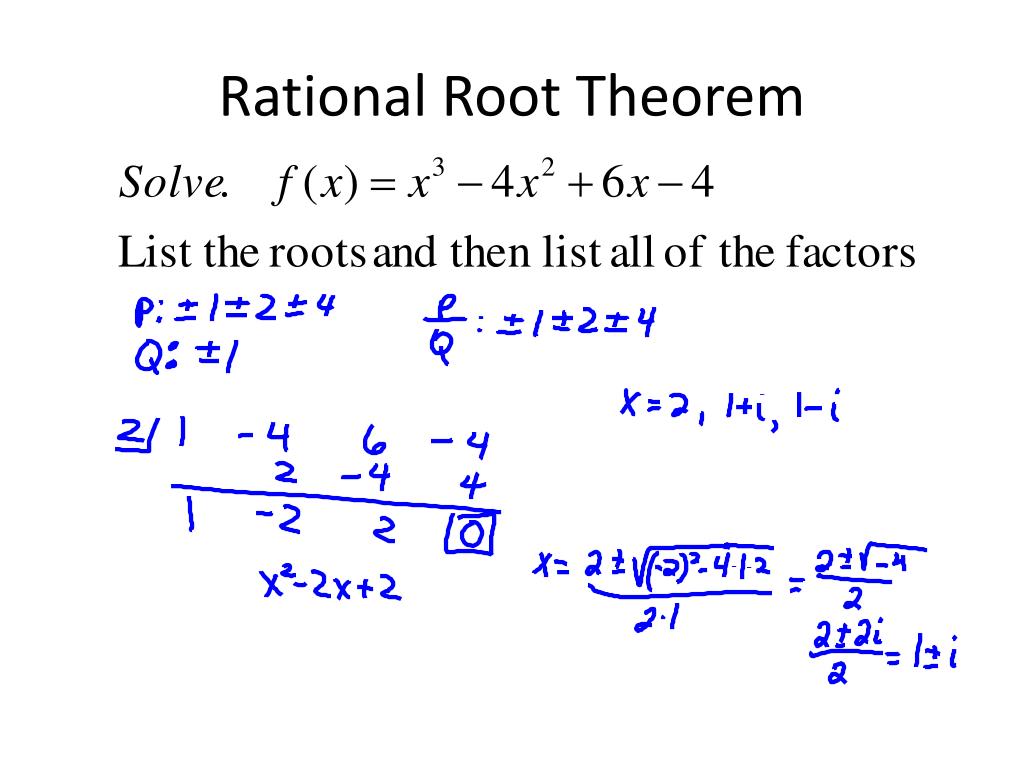
Complex Root Theorem. To understand the theorem better, let us take an example of a polynomial with complex roots. To find the nth root of a complex number in polar form, we use the root theorem or de moivre’s theorem and raise the complex number to a power with a rational exponent.
PPT Rational Root and Complex Conjugates Theorem from www.slideserve.com
Next, put this in its generalized form, using k which is any integer, including zero: R 1 n ( c o s ( x + 2 k π n) + i s i n ( x + 2 k π n)) r^ {\frac {1} {n}}\left (cos (\frac {x+2k \pi} {n}) + i\ sin (\frac. The scope of this theorem is within finding the roots and powers of complex numbers.
Complex Conjugate Roots Can Be Described Using The Conjugate Roots Theorem:
To find the nth root of a complex number in polar form, we use the root theorem or de moivre’s theorem and raise the complex number to a power with a rational exponent. For example, in quadratic polynomials, we will always have two roots counted by multiplicity. To find the roots of complex numbers.
In Mathematics, A Complex Number Is An Element Of A Number System That Contains The Real Numbers And A Specific Element Denoted I, Called The Imaginary Unit, And Satisfying The Equation I 2 = −1.Moreover, Every Complex Number Can Be Expressed In The Form A + Bi, Where A And B Are Real Numbers.
To prove this, we need some lemma first. Complex conjugates are a major part of the conjugate root theorem, so we definitely want to be familiar with them. Complex conjugates are two complex numbers, so they have the form a + bi, where a.
A Field F F With The Property That Every Nonconstant Polynomial With Coefficients In
A number that can be expressed in the form a + ib is referred to as a complex number. Next, put this in its generalized form, using k which is any integer, including zero: These are the cube roots of 1.
Two Examples Of Roots Are 3 And 5.
We recall the conjugate root theorem, which states that the complex roots of a quadratic equation with real coefficients occur in complex conjugate pairs. A 2 + b 2 ∈ { 1, 5 } now we have to think all the ways these numbers can be written as the sum of two squares of complex numbers. In general, use the values.
All Four Of The Roots Are Real, Two Of The Roots Are Real And The Other Two Form A Nonreal Complex Conjugate Pair,.
So, the possible cases are: If the theorem finds no zeros, the polynomial has no rational roots. In this example, we are given that a quadratic equation with real coefficients has a complex root.