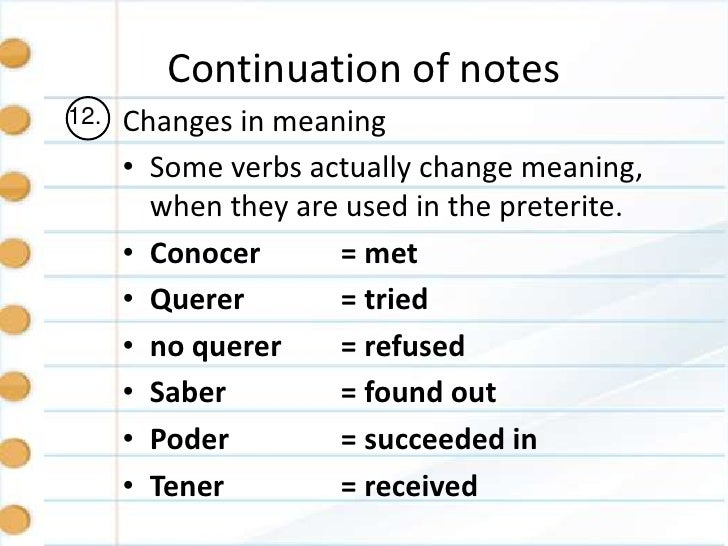
Saber Preterite Meaning. Broadly speaking, conocer implies a. Saber and conocer are unaffected by whether they are positive or negative.
Preterite tense from www.slideshare.net
Saber siempre supe que quería ser profesor. We can use the verb querer whenever we want to talk about loving or wanting something. Saber and conocer in the preterite in the preterite , both saber and conocer can have other meanings.
Learn How To Use 'Saber' And 'Conocer' In.
Saber in the indicative preterite the indicative preterite of saber is used to talk about actions completed in the past, at a specific point in time. Saber and conocer are unaffected by whether they are positive or negative. You only find out something once, much like a realization it happens in an instant and then it’s over.
In This Case, “De Él”.
This video covers the irregular verb in the preterite: Saber = knew (some fact) él sabía la dirección de memoria. I always knew i wanted to be a teacher.
Where English Has One Verb Spanish Has Two, As Is The Case With Ser And Estar And Haber And Tener.
Back to top saber in the indicative imperfect I got new shoes yesterday would be ayer tuve zapatos nuevos. Saber appears on the 100 most used spanish verbs poster as the 9th most used irregular verb.
In Addition To Tried, The English Verb Attempted To Is Another Situation In Which The Preterite Of Querer Will Be Used.
Facts, information and 'how to'. In spanish, the verbs 'saber' and 'conocer' are used to express the meaning of 'to know' in english. This verb is irregular in the preterite tense, but regular in the imperfect tense.
Using The Chart Below You Can Learn How To Conjugate The Spanish Verb Saber In Preterite Tense.
The red dot () above denotes an irregular conjugation. I had a spanish teacher once tell me that in the preterite tense 'tener' means 'got', 'saber' means 'found out', and 'conocer' means 'met'. Indicative, past tense, participle, present perfect, gerund, conjugation models and irregular verbs.